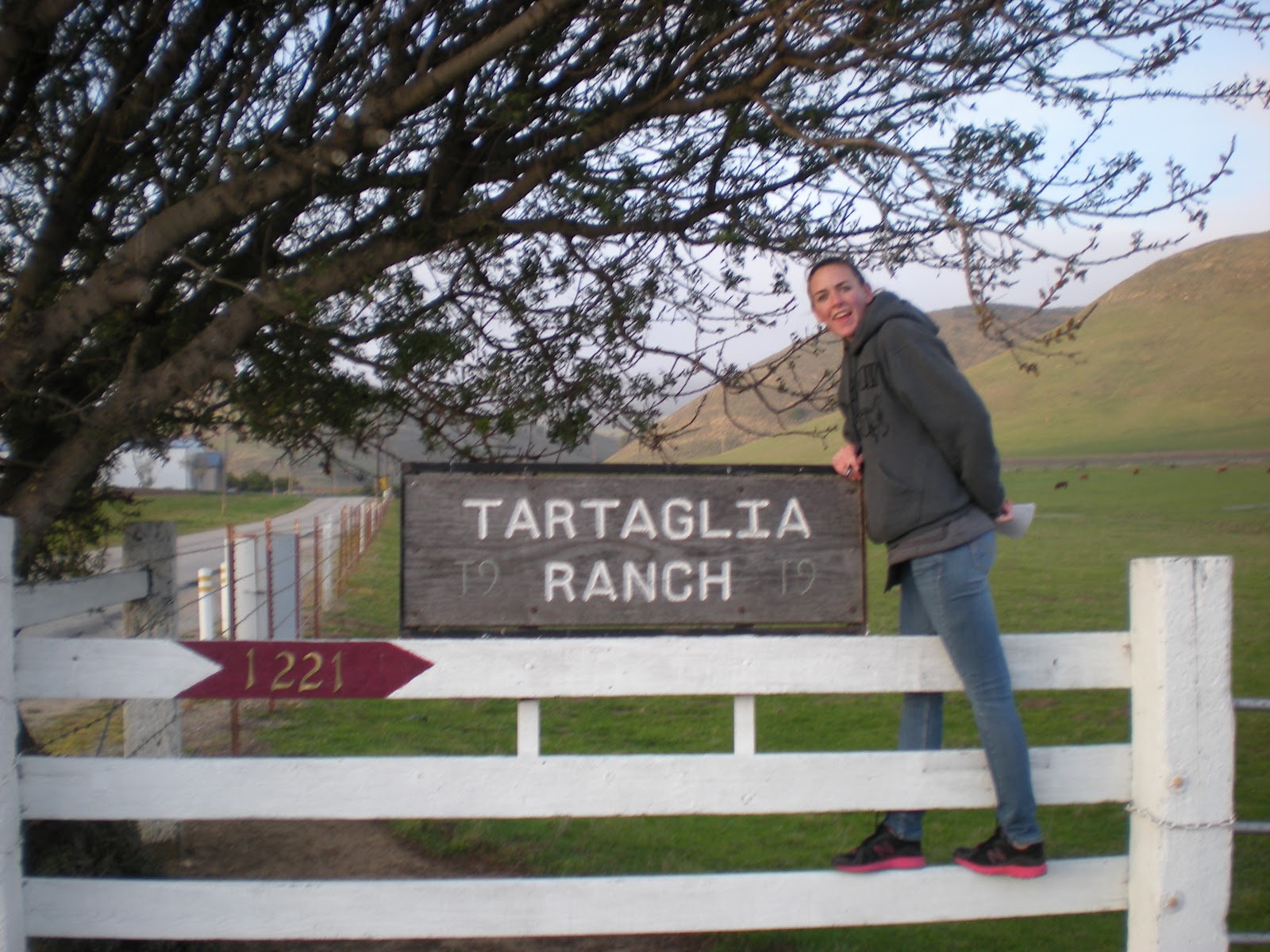
Today a new task made its way onto my running list of thing to do before I graduate from Poly. This afternoon, a friend and I, embarked on a journey to visit every building on our college campus. In the almost five hours we spent discovering our campus, wandering in circles, and walking for miles we found a many hidden treasures on Cal Poly's Campus. From halls we have never seen before, ancient gyms plastered in Cal Poly Football posters, and the Old Power House, the oldest building on Poly's campus and a historic location. The adventures were endless and we only made it 48 of the numerous buildings. Today we experienced Cal Poly's history. We discovered short cuts. We embraced our campus, our home. We found our taking more pictures than the 48 required pictures for this task. Interesting and fascinating views were found around every corner. Today we found an abandon building, a historic location, we befriended some bulls, and talked to the lambs. I'm excited for all the adventures that lay on this in my future.
Forests in the California and North America are in a dire condition. A lack of management has left a great amount of American forests in flames or, even worse, decay. In the midst of this ecological crisis, forestry experts, the general public, and the media agree that our forestlands must be protected.
This apparent consensus on the need for the conservation of our forests can very easily give an optimistic outlook for our forests. However, conditions have not seen improvement- in fact they have worsened. According to the California Forestry Association, there has been a 300 percent increase in Californian wildfires over the past ten years. Today ten million acres and three million homes in California are at a high risk of severe wildfire.
According California State Fire Marshal, Kate Dargan, we have not seen improvement because of a fundamental communication gap between the experts of the forestry industry and the general public. In a video produced by Forests For the Next Century, Dargan observed that the public generally believes that the best way to protect our forests is by doing nothing, however forestry experts, she says, believe that the best way to protect forests is through management.
As a result of over a hundred years of fire suppression and strict California forestry legislation, such as the Forest Practices Act, California’s forests are extremely dense and over-crowed. Now thousands of trees can be found on acres, which in the past only held 50 to 75 trees.
According Dr. Doug Piirto, the Natural Resources Management and Environmental Sciences Department Head at Cal Poly, “too many trees per acre is not healthy”. Research conducted by United State Department of Agriculture Forest Service, has actually gone even further to state that thinning in forest stand can reduce wildfire severity by up to 60 percent and reduce greenhouse gas emissions by up to 65 percent.
These dense forests pose many problems. According to Forests For The Next Century, 74 percent of the 191 million acres of National Forest land is in a serious fire condition. Furthermore, in addition to wildfire concerns, when more trees are growing in an area than the soil can support, these trees will become increasingly stressed – and stressed trees are far more susceptible to incest infestation than healthy stands. These disease and insect infected trees also pose a large threat to global warming, because only one quarter of Carbon Dioxide released into the atmosphere by forests is smoke, the rest is directly because of the decay of trees.
Management is the key to a healthy forest environment. Thinning removes fire ladders-which have only appeared over the past years as a result of increasingly dense stands. Dr. Piirto said that foresters along with other professionals have helped this country become as efficient as it is a fire management.
California has one of the most diverse variety of forest ecosystems, from Coastal Redwoods- the tallest trees, Giant Sequoias- the largest tress, to Bristlecone Pines- the oldest trees. Every forest has different objectives; however management can play a huge role at the success of those objectives. Dr. Piirto participated in conducting a study at Lake Tahoe, that showed land and home had a higher value near forestland that was properly thinned than in areas where it was not.
North American forests are in a huge crisis that affects every person. The solution is also relatively clear. Forestry experts are trained to manage tomorrow’s forest and to meet society’s objectives. However strong negative public opinion towards many logging practices, a fundamental communication barrier, and California’s regulations, that are the strictest in the nation, are all huge obstacles to success.
However, Cal Poly’s Dr. Piirto is an optimist. He puts a considerable amount of faith in the general public of this state. “The California public recognizes that one size doesn’t fit all and the need for a working forest to meet the demands of a growing population” he said. He also said that Californians are smart.
The past ten years have been California’s worst fire years. Yet a considerable shift in the public belief on forestry conservation has not occurred. Dr. Piirto looks to growing concerns over climate change as a possible push towards this change in public opinion. Forestry experts believe they have a powerful tool in the fight against climate change.
Cal Poly is successful at educating students in this area. In order to become a Registered Professional Forester, or RPF, a forestry professional must have a forestry degree from an accredited university. Cal Poly’s Forestry and Natural Resources major is accredited by the Society of American Foresters and therefore prepares students for a career in managing tomorrow’s forests.
Cal Poly’s Swanton Pacific Ranch also offers a Forest Stewardship Council certified school forest. Students can learn in true Cal Poly fashion on frequent field trips to the forest, which has profited six million dollars over the course of its operation. Student can also apply management skills on this stand that uses an even age management system. Dr. Piirto also points to the faculty of the department as huge resource. Whether being studies in the area or databases developed by Cal Poly, the faculty has great experience in this area.
"I believe in the future of agriculture, with a faith born not of words but of deeds." These words mean a lot. This statement is not only the opening line in the creed that outlines the beliefs of the largest youth leadership organization in America, but it also expresses the lifestyle that the over 400,000 FFA members and other supporters of agriculture have begun to lead. My freshman year in high school, these 17 words held little to no significance in my life. This was the starting point of my memorization of the remain five paragraphs of the FFA Creed. Today however, I can proudly say that this simple and yet profound statement accurately sums up my involvement in the agricultural industry.
Over the past years, these words have had many different impacts on my life. Throughout my time as an FFA officer at various levels, the FFA creed fueled my passion for investing in the future of agriculture, primarily through the future leaders of the FFA Organization. Later in my life, my belief in this can be seen by enrolling in agriculture education at Cal Poly, and investing my education in this industry. Today, living out my belief in the agricultural industry through my actions, took on a new form.
In my opinion, just as important as training and equipping future leaders of the ag industry is effective communication with those who ultimately have a huge influence over the success and future of agriculture. Jim Brock, one of the individuals who made Cal Poly Ag Communications possible once said that the general public and media negatively effected agriculture not because of bias, but because they are ignorant of the fact and realities of agriculture. What makes this statement profound in my mind is that Brock, knew this to be true over 25 years ago. Over the past 20 years the conditions for agriculture in the media and public policy has not gotten any better. Governmental regulation like Prop 2 and a increased presence in the media by HSUS and PETA. The 2% of our population that not only provide food and fiber for the United States, but also the world, has not been properly connected to the public.
Today, students dedicated to spreading the message of agriculture, worked across the nation. WTF (Where's The Food, Without The Farmer) Day hit the nation. I represented agriculture with seven other Cal Poly students at UC Santa Barbra, a campus without an agricultural program. The eight of us, had many conversations and provided ways for university students entering the consumer market to identify where the final product in a supermarket actually come from.
San Luis Obispo is a whole new world in comparison with my home in Northern California. I came from a small town where everyone knew everyone else. I am still amazed by the vast size of this state. I have been south of San Luis Obispo, one time in my entire life. This is my definition of extreme southern geography, and yet California is so much more. This is amazing to me, especially from and agricultural outlook. As I have begun courses and activities here in San Luis Obispo, I continue to learn more about myself and expand my knowledge.